
Zombie Copycats
A trio of mid-century imitators that chased the legend in its heyday.
Links About Drinks
We all know about the Chartreuse shortage. Several years ago, the monks who make the high-proof, herbal booze decided to limit production, resulting in shortages and high prices in some states. In Philadelphia, bartenders have apparently responded by hoarding the stuff, and in some cases by making their own. If you’re struggling to find Chartreuse, you can blend a close-enough substitute on your own at home, and it’s even less expensive, per ounce, than the real stuff. But I’ve started to see bottles back on shelves, especially in the greater Boston area, sometimes for quite reasonable prices. The make-your-own strategy might not be necessary much longer. (Relatedly: Bloomberg reports that Chartreuse is now a sort of liquid luxury good in Paris.)
Earlier this summer, while preparing for a Slate piece on the American Founding and cocktails, I read Cocked and Boozy, Brooke Barbier’s new history of America’s origins through the lens of booze. Barbier argues that America’s origins can’t really be understood without understanding the country’s relationship with alcohol. Booze of all kinds, but especially rum, was a central player in the drama of the American creation. This week, at his newsletter, drinks writer Henry Jeffreys makes a similar argument about the entirety of human civilization. Some of his arguments about alcohol’s effects on socialization will be familiar to readers of this newsletter; cocktails can help solve the party crisis. But I was especially taken with his linkage of art and literature to alcohol. If current drinking trends continue, I expect we will see more arguments along these lines.
At the same time, you can go a bit overboard with this sort of thing. In a social media video, for example, Esquire Editor-In-Chief Michael J. Sebastian makes the case that hangovers are objectively good for you. I wouldn’t go that far. On the other hand, this month’s cocktail, the Zombie, might not exist without it. According to legend, the drink was created for a hungover businessman who later said it made him feel like “the living dead.” And the drink’s infamous two-per-customer limit, while not unreasonable given that it originally contained four ounces of rum, was a sort of winking test of one’s boozy mettle. Speaking of Zombies…
The Legend of Zombie Island
I have heard tell of a mysterious Greek isle that I have come to think of as Zombie Island.
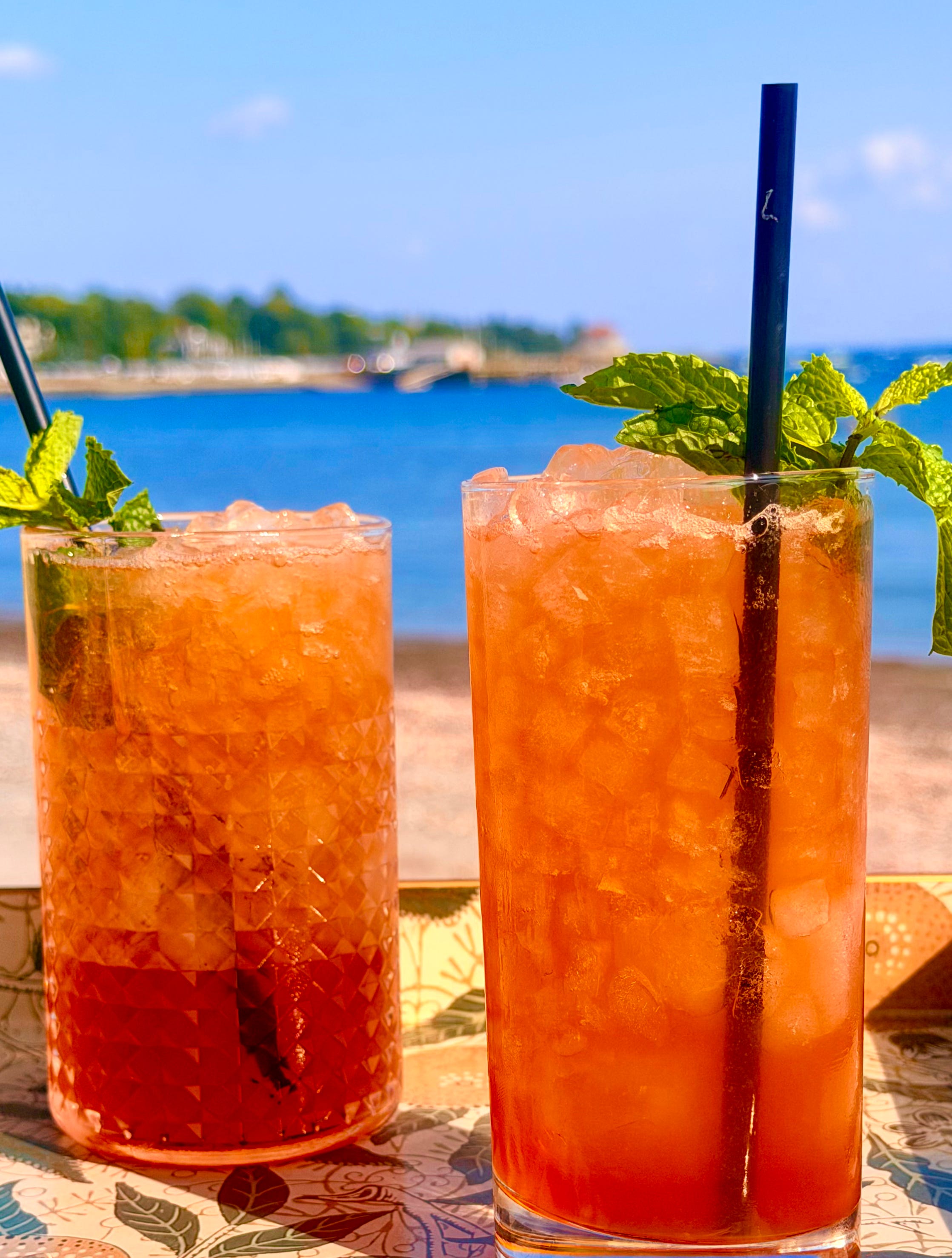
That’s not its official name, of course, and, rather sadly, I’ve never even been there myself. But one of my closest friends spends a couple months there each year. In his telling, nearly every bar and many restaurants serve something called a Zombie. And every single one of them is different.
Sometimes the differences are subtle. Sometimes they are not. But the Zombies of Zombie Island are, to some degree or another, house signatures, custom creations born not, in most cases, from studying tiki history and adapting Donn Beach’s original recipe, but from the idea of the Zombie, the icon, the legend.
Most of these Zombies are based in rum and fruit juice and sweetener of some sort. But other than that, they share very little of the original drink’s specific DNA. Rather it’s more of a cultural affinity. They are ideological fellow travelers, co-religionists practicing the Way of the Zombie.
So a Zombie from Zombie Island might contain passion fruit, or pineapple, or papaya juice. Bitters and falernum, the key spice notes in Donn Beach’s original recipe, may or may not appear.
Even stranger things might be incorporated as well. I’ve seen a photo of a menu from one of the island’s bars that lists a Zombie…with “jam.”
There is, to be clear, no jam in a Donn Beach Zombie.
The rum is up for debate too. Beach’s original was built on a three-rum blend of gold Puerto Rican rum, dark Jamaican rum, and 151 Demerara rum. A Zombie on Zombie Island, in contrast, might have light rum, or dark rum, or some combination; it might have some sort of 151-proof rum, which might or might not be incorporated as a float. At some Zombie Island bars, the rum might be free poured rather than measured, along with the juice, so there’s no way to really know exactly how much rum is in any given drink or how potent it is. It might be four ounces, like Donn Beach’s original Zombie, or it might be less. It might even be more.
At least this is what I hear. It’s a legend. I haven’t been there. I don’t even know the real name of the island. It’s all Greek to me.
But as legends go, it’s plausible enough. The Zombies of Zombie Island are echoes of echoes, stories told about mysterious shadows on the wall, local evolutionary tributaries that have departed from the main line. In this way, they resemble so many Zombies throughout history, even those contemporary to, and in competition with, Donn Beach himself.
Last week, we looked at Donn Beach’s original Zombie recipe, some of the questions that recipe raises, and the specific question of which bottles of rum one might choose to fill it out.
If you’re new to the drink, that’s where you should start. Beach’s version is now widely accepted as the canonical version of the Zombie, arguably the best version, or close, and certainly the recipe and conceptual breakthrough from which all others flow.
And long before my friend started telling tales of Zombie Island, there were many, many others. So this week we are going to look at that drink’s early imitators.
We will examine recipes for three different drinks that bill themselves as Zombies, all of which date to the 1930s or 1940s, and all of which depart markedly from Donn’s original formula.
The first two on our journey are best understood as historical curiosities that help one understand what a Zombie is, as well as what it isn’t.
A third variation departs from Beach’s formula in many ways, but makes for a truly tasty tipple that’s juicier, milder, and perhaps more accessible than Beach’s spicy, complex, almost fiendishly intense cocktail. If you just want to make the best recipe from this collection, skip to the very end.
The fact that there were multiple Zombie copycats in circulation a decade after the drink’s creation tells you just how far and wide the Zombie had spread. The significant variations in the recipes, meanwhile, tell you just how little agreement there was about what the drink actually was.
From its earliest days, this was a drink with legends, lore, and a cult-like following. But as often happens, despite their devotion, the cultists couldn’t quite agree on what, exactly, they believed.
ZombieCats?
One of the most amusing things about these Zombie Copycats (ZombieCats?) is that they were often proffered by people who were more than a little bit skeptical of the drink and the wild-eyed mythology that had risen up around it.
Specifically, people like David Embury.
Longtime readers of this newsletter know that David Embury is this newsletter’s spiritual inspiration. Embury was a tax lawyer by trade, but he greatly enjoyed cocktails as well. So as he traveled, he obtained recipes from bars and restaurants, eventually collecting them all in The Fine Art of Mixing Drinks, one of mid-century America’s most important cocktail books.
Embury’s book was an attempt to systematize and translate the era’s cocktails for home bartenders; he was an enthusiastic and knowledgeable amateur writing for other home bar enthusiasts. He wanted to help improve the quality of at-home cocktails. His goal was to move beyond mere recipes; he wanted to teach people how to think about drinks, and how to make them well.
So it is quite funny to read his entry on the Zombie and see that it is more of an extended argument with its existence.
In his entry on the drink, he grumbled about its multi-rum construction. (“The multiplicity of various rums and other ingredients is an offense against the first principles of drink mixing.”) He griped about the inclusion of 151 rum. (“Adds nothing to the flavor of the drink.”) He complained about the use of mysterious secret ingredients. (“All this mystery, of course, is calculated to inspire curiosity and thus advertise the drink.”)
And he threw up his hands in despair at Donn’s legendary two-per-customer limit, seeing it for the cynical marketing trick that it was. The Zombie, Embury famously declared, was “undoubtedly the most overadvertised, overemphasized, overexalted, and foolishly feared drink whose claims to glory ever assaulted the eyes and ears of the gullible American public.” In so many ways, Embury had the Zombie pinned down.
He also lamented that the drink’s construction was notoriously unstable: “Twenty different bars serving this drink will probably put out eighteen to twenty different versions of it.”
Still, he allowed that the drink was “not bad at all.” He then offered a recipe that he admitted was an approximation.
But that recipe raises almost as many questions as it answers.
