
Cynarize Your Sidecar
What happens when you replace Cognac with bittersweet artichoke liqueur?
Links About Drinks
High-end cocktail bars are releasing short films as promotional material. Vinepair’s headline asks whether this means bars are becoming social media content creators. Clearly, they are: Just look at the cutesy, clever, thoughtfully designed Instagram videos being produced by Schmuck, a can’t-get-a-table cocktail hotspot in New York. But what you’re increasingly seeing is that these bars are just producing commercials. And some of them are taking on an artsy, cinematic flair. To me, this just looks like a somewhat less expensive, social-media-friendly modern update of the strategy that BMW used more than 20 years ago when they hired Tony Scott, Guy Ritchie, John Woo, Ang Lee, and a bunch of other Hollywood directors to make a series of online shorts. I remember watching these while I was in college, when they first came out. They were pretty good!
“‘I was buying Pappy by the case, at cost,’ recalls Monique Huston, vice-president of Winebow’s spirits portfolio. ‘There was no Bourbon Trail, no romance. These were industrial plants.’” Related.
The Wall Street Journal reviews wine Substacks.
The best bar cart is actually just a home bar. Yes, you need some space, but less than you might think. Mine is within a couple inches of six feet by six feet. And some of the cabinets are just old junk-shop finds.
Of Cynar and Star Trek
Ensemble television shows sometimes have episodes devoted to a specific supporting character, or even a recurring guest character, often a fan favorite.
I grew up watching Star Trek: The Next Generation—nerd alert—and was always thrilled when there was an episode centered on Lore, the android Data’s emotionally capable evil twin, because it meant Brent Spiner could let his freak flag fly. The episodes with Q, the mischievous god-being played with such self-satisfied gusto by John De Lancie, were always pretty great too. These episodes would subject these high-intensity, oddball characters to new situations, new contexts, new dramatic possibilities. The goal was to put them to the test, to reveal their true characters. Then you could see who they really were.
As a fan, you looked forward to these episodes. You wanted more of them. The prospect of these characters appearing always loomed in the background. But you couldn’t have too many of them. Part of the thrill was the scarcity. You never knew when you’d tune in and Q would return, comically lording himself over Patrick Stewart’s bald pate. Not this week. But maybe next?
This is a Cynar episode.
Cynar has many virtues. It’s reasonably inexpensive, widely available, and low-proof in a way that reads as strong.
But its chief virtue is its adaptability.
For example…
You can put Cynar in a Manhattan, in place of bitters.
Or you can put Cynar in a Manhattan, in place of whiskey.
You can put Cynar in a Daiquiri, as a modifier. You can put Cynar in a sour, as the base ingredient.
You can put Cynar in a smash.
You can put Cynar in a stirred-and-boozy Sazerac, or a bubbly tonic highball.
And of course you can put Cynar in a Mezcal Negroni.
You can put Cynar in just about anything. And you should. You can think of this as the process of Cynarization.
Cynarization is when you put Cynar in an already existing cocktail that does not normally have Cynar in it. And then it tastes good. Because it has Cynar in it. (The John De Lancie episodes of Star Trek were, in some sense, examples of Q-ification.)
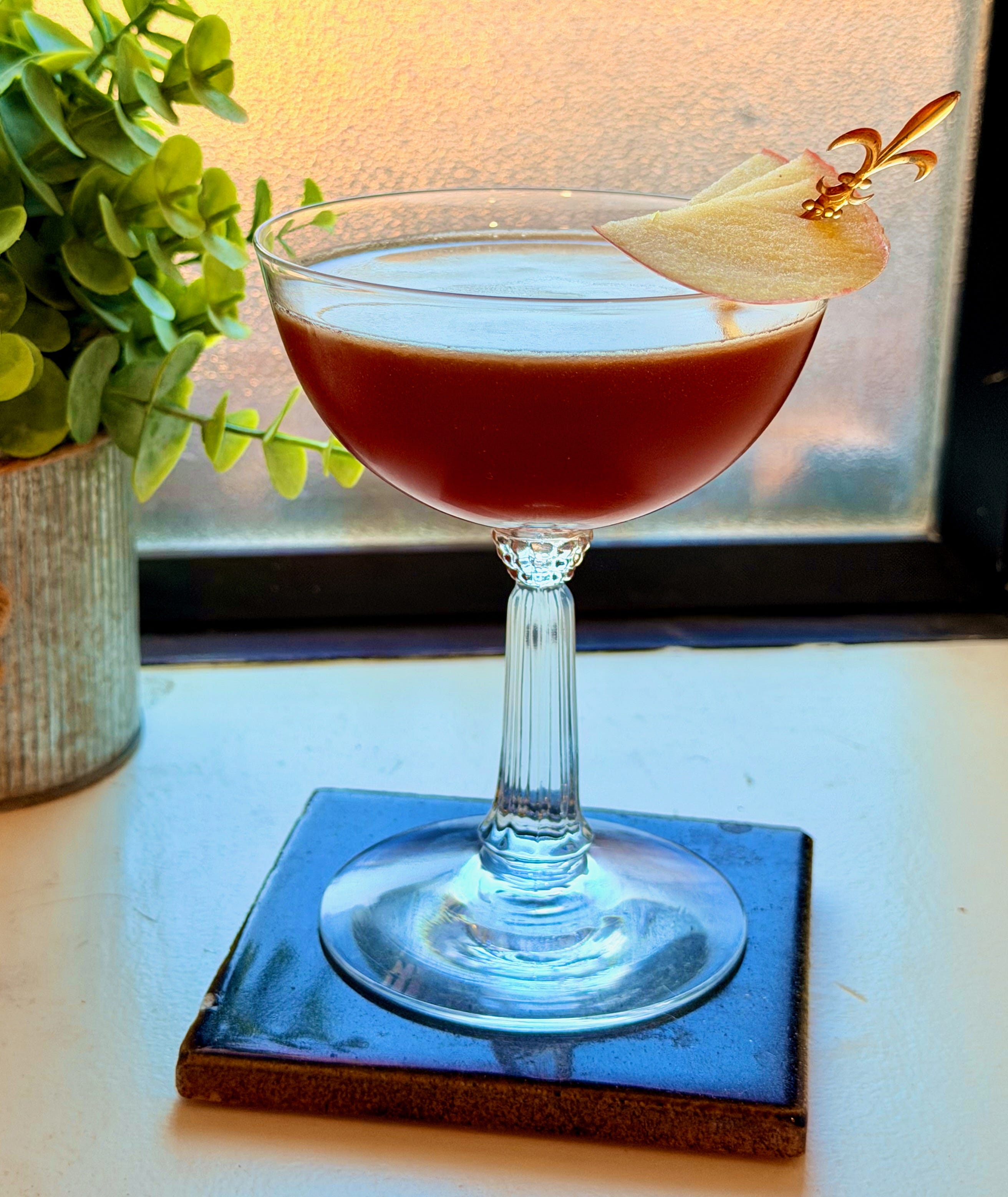
As noted, many well-known drinks have already been Cynarized. But not all of them. So this week we’ll continue down the path of Cynarization by Cynarizing a Sidecar. Specifically, an apple-y, spicy, fruity, Fall-y (Fall-ish? Fall-esque? Fall-en?) Sidecar. (Yes, it follows the five-ingredient rule.)
Someday, perhaps, we will Cynarize the world. But for now, it’s one drink at a time.
Moreau Money, Moreau Problems
There aren’t enough Sidecar riffs in the world. And probably not enough Sidecars. Which is understandable. Most Sidecars are strange beasts. You can make a Sidecar well, but most bartenders don’t know how. This results in a lot of Island of Doctor Moreau-like creations—terrifying, tragic, a little bit deformed, quite possibly lacking a soul. These are sidecars only a madman, or an aging Marlon Brando, could love.
Some people pretend to love Sidecars. But what they really love are the sugar rims. This is a terrible mistake. The sugar rim is the worst part. Yes, it looks nice, but that hit of granular sugar cannot be balanced, cannot be calibrated into the drink. It’s like you’ve eaten a small shard of rock candy before consuming an orange-y, unbalanced, brandy sour. I’m sure some cocktail wizard could, maybe even has, made a delicious Sidecar with a sugar rim, but I’ve never had one. And in general, I don’t recommend rimmed cocktails at home—at least not unless your main goal is to make a drink that tastes good on Instagram.
To be clear: I have nothing against Instagram cocktails; I post them myself. And I learn from some of the better cocktail nerds on the site. But cocktails cannot taste good on Instagram. They can only look good. Ultimately you have to drink the damn thing.
The thing to understand about a Sidecar is that it’s really a Margarita, But With Cognac. And/or vice versa. They should have called the Sidecar the MBWC.
The Cognac makes the drink classier, cooler, more chic. As the Oxford Companion to Spirits and Cocktails notes in its entry on the drink, the Sidecar has endured “as a symbol of sophisticated drinking for a century.” A 1940s version that used an ancient brandy cost five full dollars—equivalent to something like $90 today. This was probably the birth of luxury cocktails.
Our Cynarized Sidecar is not a luxury cocktail, except in the sense that every well-made mixed drink is a luxury.
But just as the use of Cognac has the effect of making an ordinary Sidecar classier, Cynar makes a Sidecar weirder, more unusual, and, in my opinion, more interesting. It mixes things up, causes a bit of chaos, and forces other ingredients out of their comfort zones, revealing them in novel ways. Faced with its anarchic presence, tou get to see your usual cast members in a new light. Once again, it’s a lot like Lore and Q.
Cynar, Inc.
The main question you need to ask when Cynarizing a drink is how to incorporate it.
A basic Sidecar is really just a sour with three core slots:
Strong (Cognac)
Sour (Lemon juice)
Sweet (orange liqueur, and perhaps a little bit of syrup)
So how do you fold in the Cynar?